I live in Wānaka, New Zealand. Most people call me Manny. I'm a chef by trade, and in my free time I like to build things, like the sight tape generator you're reading this on. This is the story of how a chef from Mexico ended up chasing goats through the mud with a bow, and what I learned from my first guided hunt.
It covers how I got my first compound bow, my first time in the hills, and a guided hunt with a professional bowhunter. I made plenty of mistakes, and I've left them in on purpose. It took me 547 days from the day I got my bow to my first animal, and I'm still learning. The practical side, my setup changes and my gear, is in a separate post: beginner mistakes and gear guide.
It started with a gift from my dad
When I was a kid, my dad bought me a wooden bow. It was fun. Then I got an air rifle, and I forgot about the bow for many, many years.
Until recently, when bowhunting videos started showing up on my Instagram feed. I looked into a local business called Alpine Archery and messaged the owner, Mark, on 26 April 2025. Three days later I had a message saying my bow had arrived.
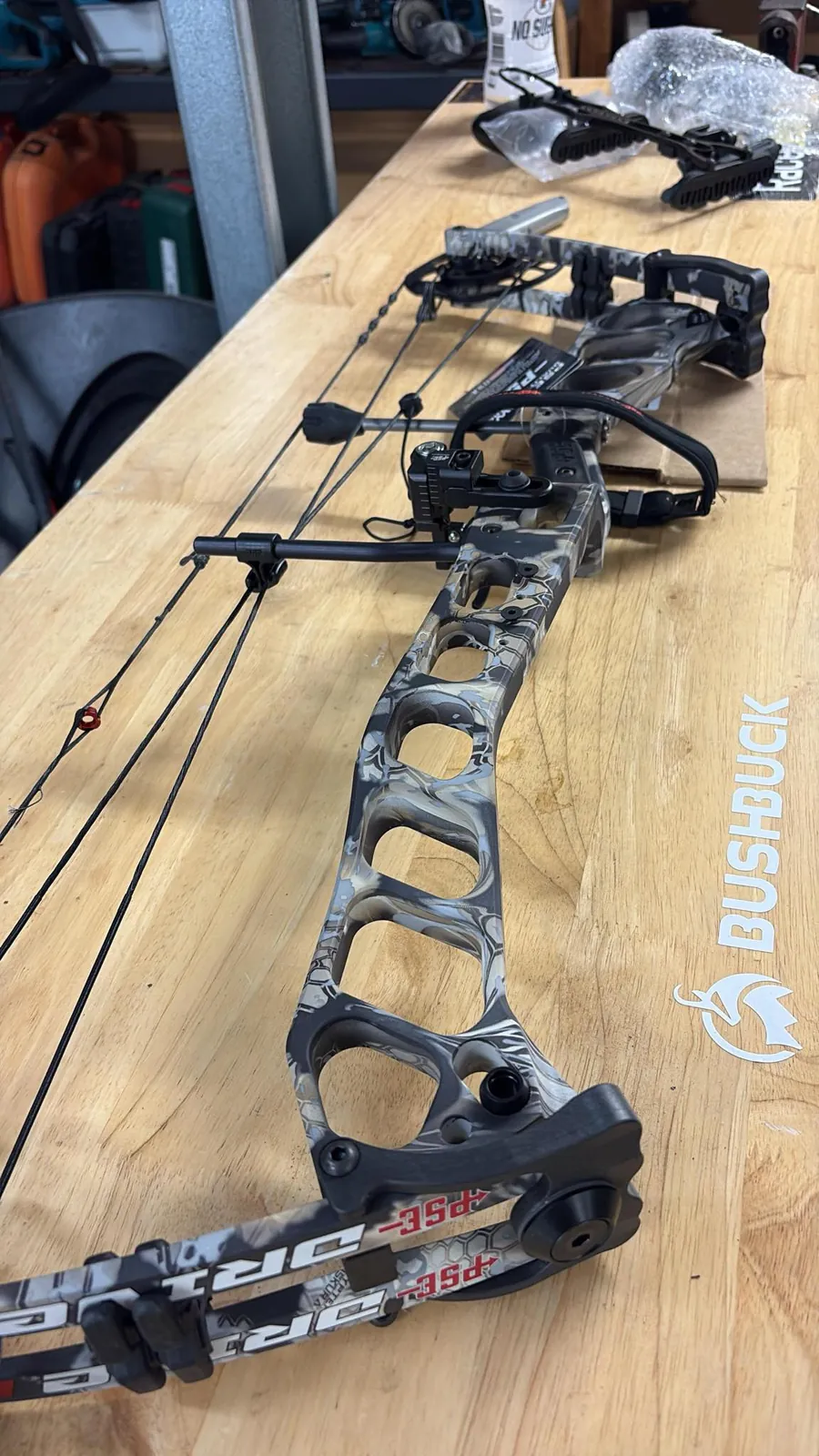
It was a PSE Drive NXT, the Pro package. Everything happened so quickly, and I was so excited. Mark tuned it for me, and my journey started right there.
Learning to pull the thing
I bought a couple of dozen Victory VForce arrows from Mark. I lost a lot of them, and plenty more got damaged or broken. That's the tax every new archer pays. Those arrows also flew funny and weren't accurate, and it took me months to realise it.
The first time I pulled the bow it was set to 45 lb, and I thought that was too much. Mark helped me set it to 55 lb, and honestly I couldn't even pull it back. So I spent a couple of good months working on my form.
I even went to the monthly shoot, where I realised I needed to put more hours in on the range, somewhere nobody could see how bad a shooter I was.
First time in the hills near Queenstown
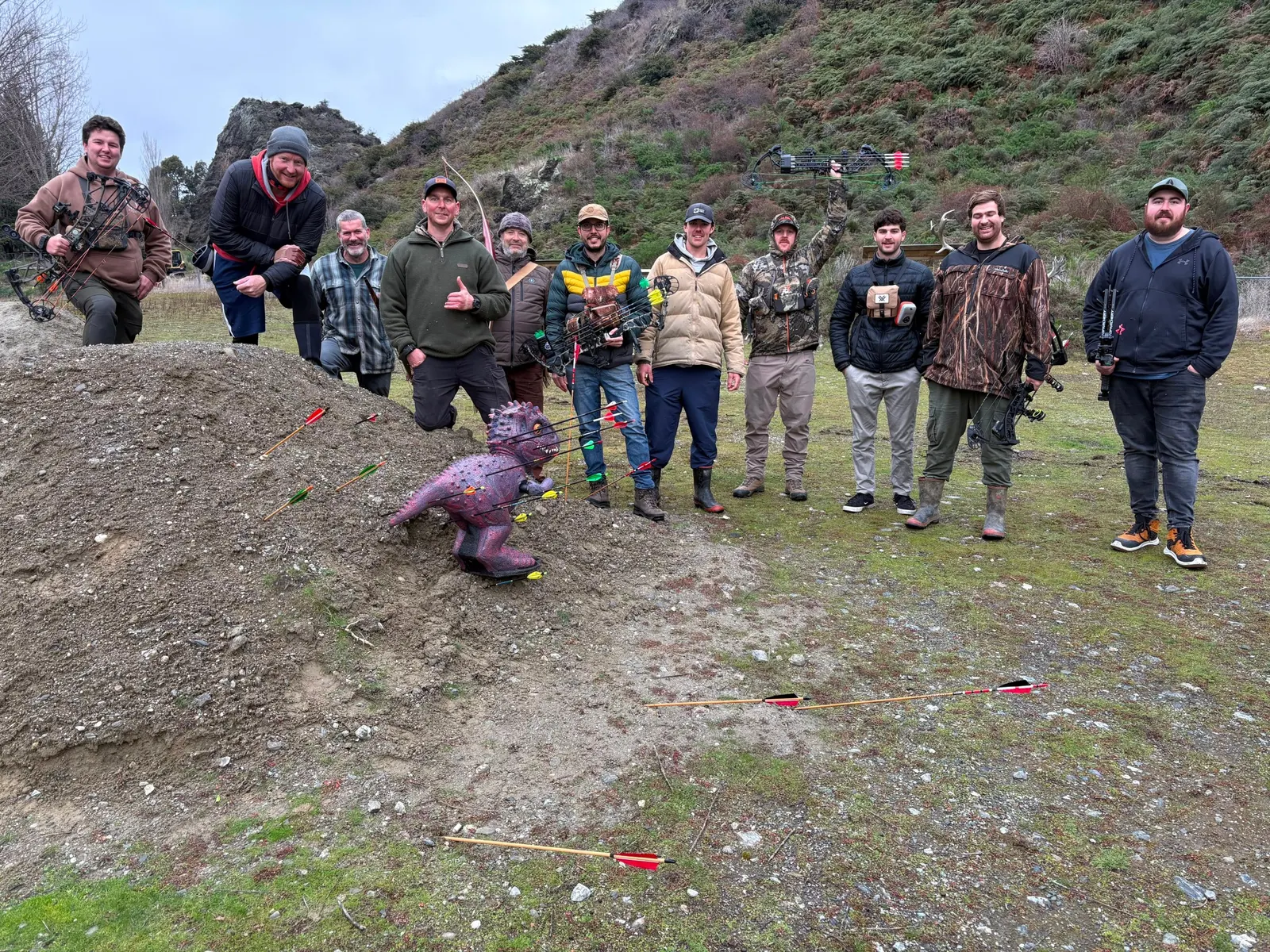
Time passed. Mark, Richard and Taewa (everyone calls him Bucky) took me to a private property near Queenstown. For the first time in my life I saw a red stag, 45 metres away. I'll be honest, I got teary. I'm from Mexico, and we don't get to see animals like that an hour from home.
We kept walking and stalking goats and fallow, but they weren't in my range. Soon after, Bucky found me a goat where I could put my skills to work.
Then he asked me something I'll never forget, and it still goes round my head: "How far can you shoot?"
In theory, 50 metres at the range. I was wrong. Everybody knows broadheads and practice points behave differently in the air. There's drag to consider, and a lot of tuning.
Good to know: Field points and fixed-blade broadheads often group differently, even when both look fine at the range. Fixed blades act like small wings, so a bow that is not tuned for broadheads can send them off to one side. This is why many bowhunters tune with broadheads before a hunt. See our broadhead tuning guide.
The goat I couldn't see
We found a goat 34 metres away on a 35 degree angle. My binoculars were still on zoom, and I couldn't even see the goat. My vision isn't the best, to be honest, but I should have been able to spot a goat at that range.
I was dragging myself through grass and mud, trying to stay silent. I told Bucky to take the shot. He made a good shot, but we couldn't find the goat.
After more walking I was exhausted. I was carrying 30 pounds on my back plus my bow, and I had blisters even though I'd bought the best hiking and hunting boots I could afford.
We spotted a second goat at 70 metres and got in close to 34. I got stuck in the bushes, and sooner than later I was chest down in the mud, dragging myself along and cursing what hunting actually was. I was ready to leave all my gear, bow included, and go home.
I took a breath, then a couple more, to calm down. Then I spotted the herd, all of them moving slowly while they ate. But my cheap Temu rangefinder had got wet, and my breath fogged the lens so the laser couldn't read. After hours of walking, I couldn't make the shot. I told Bucky I was sorry and that I had to let this animal go, because I can't shoot what I can't see or range. We tried to set up a shot, but the goats caught our scent and left instantly.
Good to know: A steep angle changes the yardage you should dial. A shot at 34 metres on a 35 degree slope does not play like 34 metres on the flat. Our Shot Solver does the angle maths for you.
Back at the range
I went home and kept practising. I changed my draw weight, my sight and my arrows, and I tuned my bow to shoot broadheads only. All of that is written up in my beginner mistakes and gear guide.
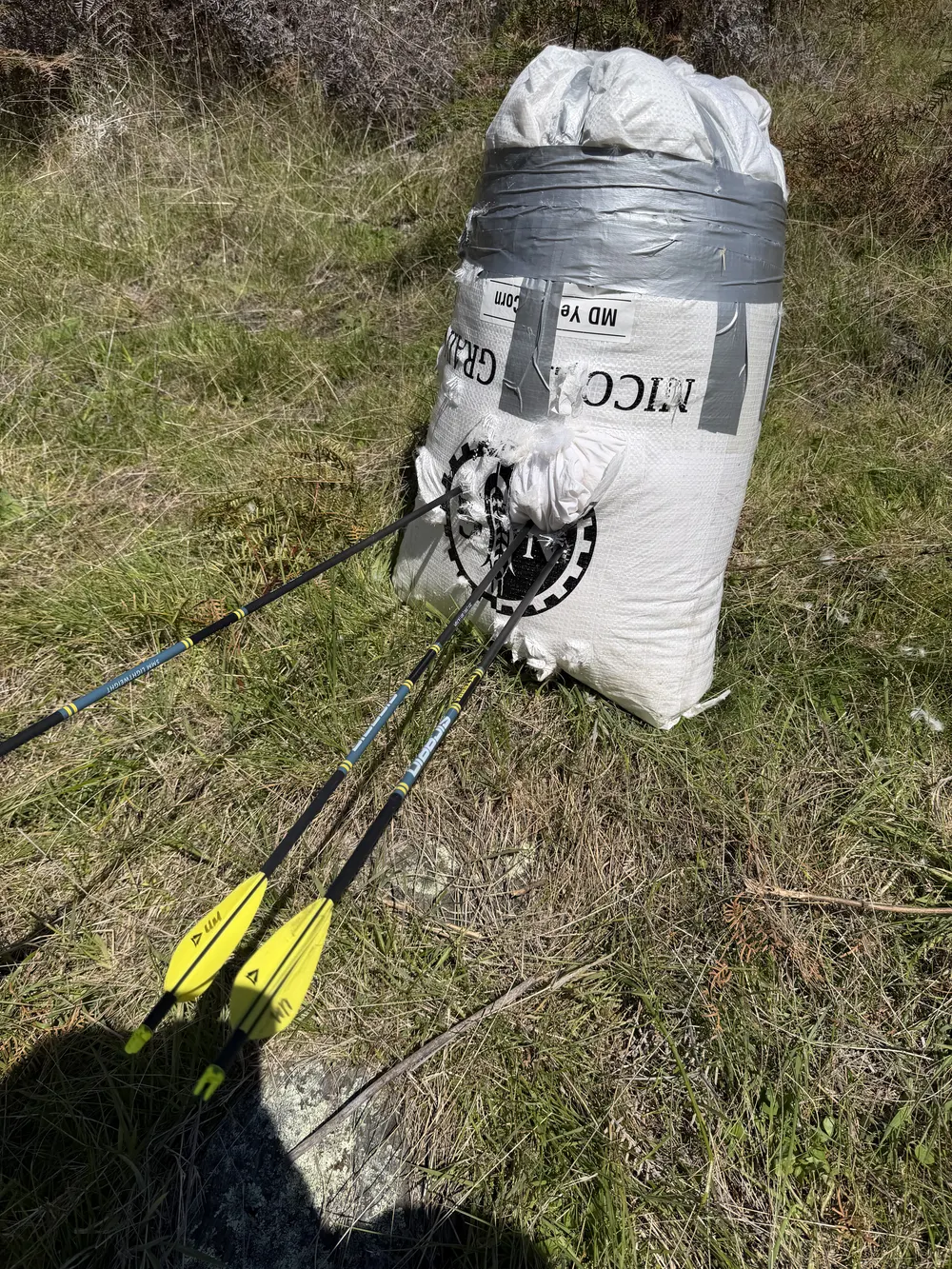
I thought I was ready. I felt ready. Three days before the hunt I was still at the range, shooting a bag target with the G5 Montec broadheads.
Then Mark offered a guided hunt
I told Mark I was going overseas for six months, and he offered me a guided hunt. I was really excited, not only because I was going out into the bush again, but because I felt I was ready.
Oh boy, I was wrong...
Guided hunt day: 28 October 2026
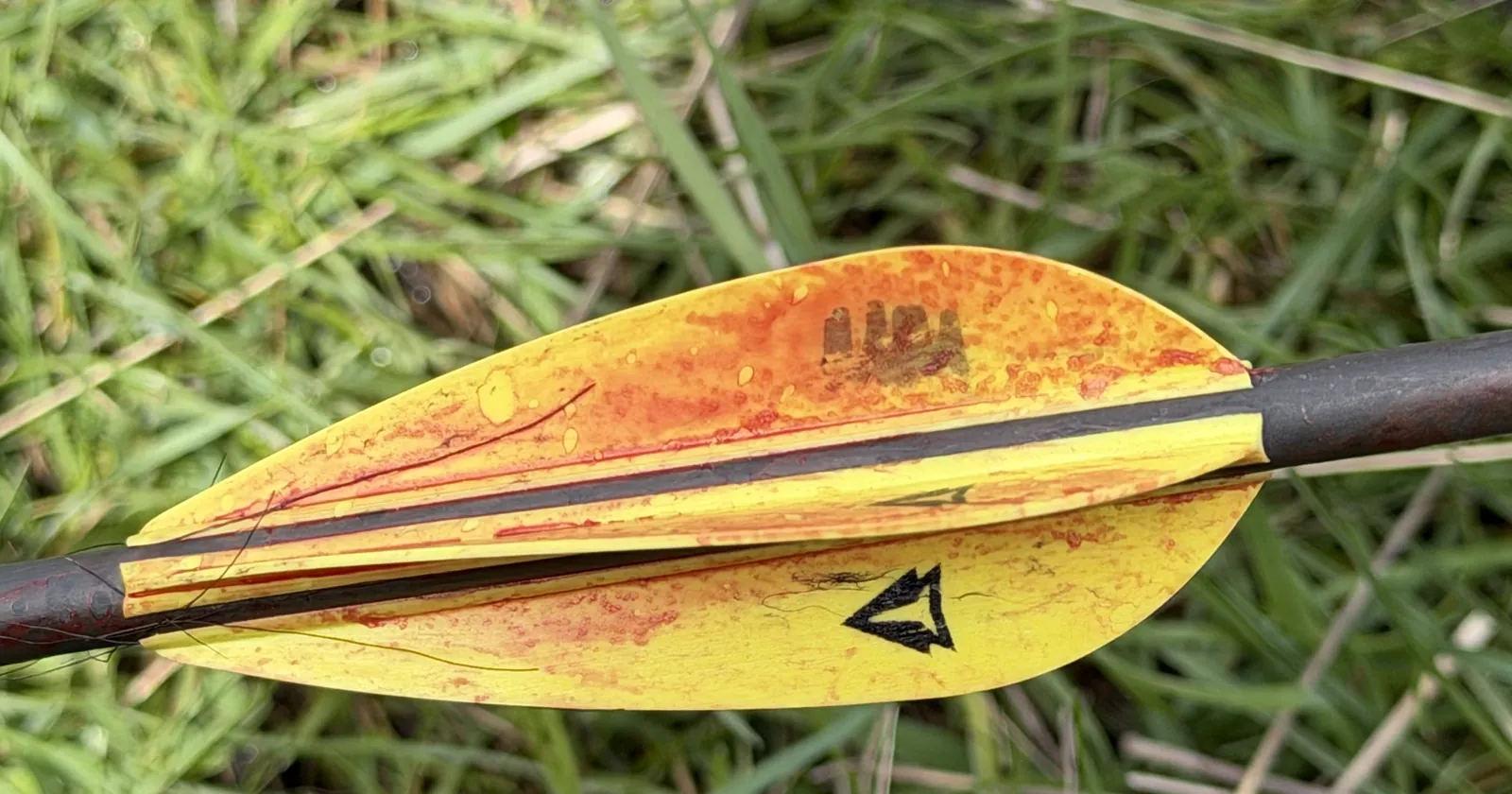
We set the date: 28 October 2026. At 4:15 pm I was taking a photo of my arrow with blood on the vanes. Let me tell you how I got there.
The drive in
We gathered everything that morning. I didn't know it, but I thought I'd be walking in. No! Mark had a 4x4 buggy, and I felt so good the moment I jumped in and he started driving through Gibbston Valley. The scenery, the clouds, the wind, the trees, the dozens of lambs we saw before we entered the secluded place Mark calls Jurassic Park, because of the number of animals everywhere on that private property. I could write a whole blog about the scenery alone.
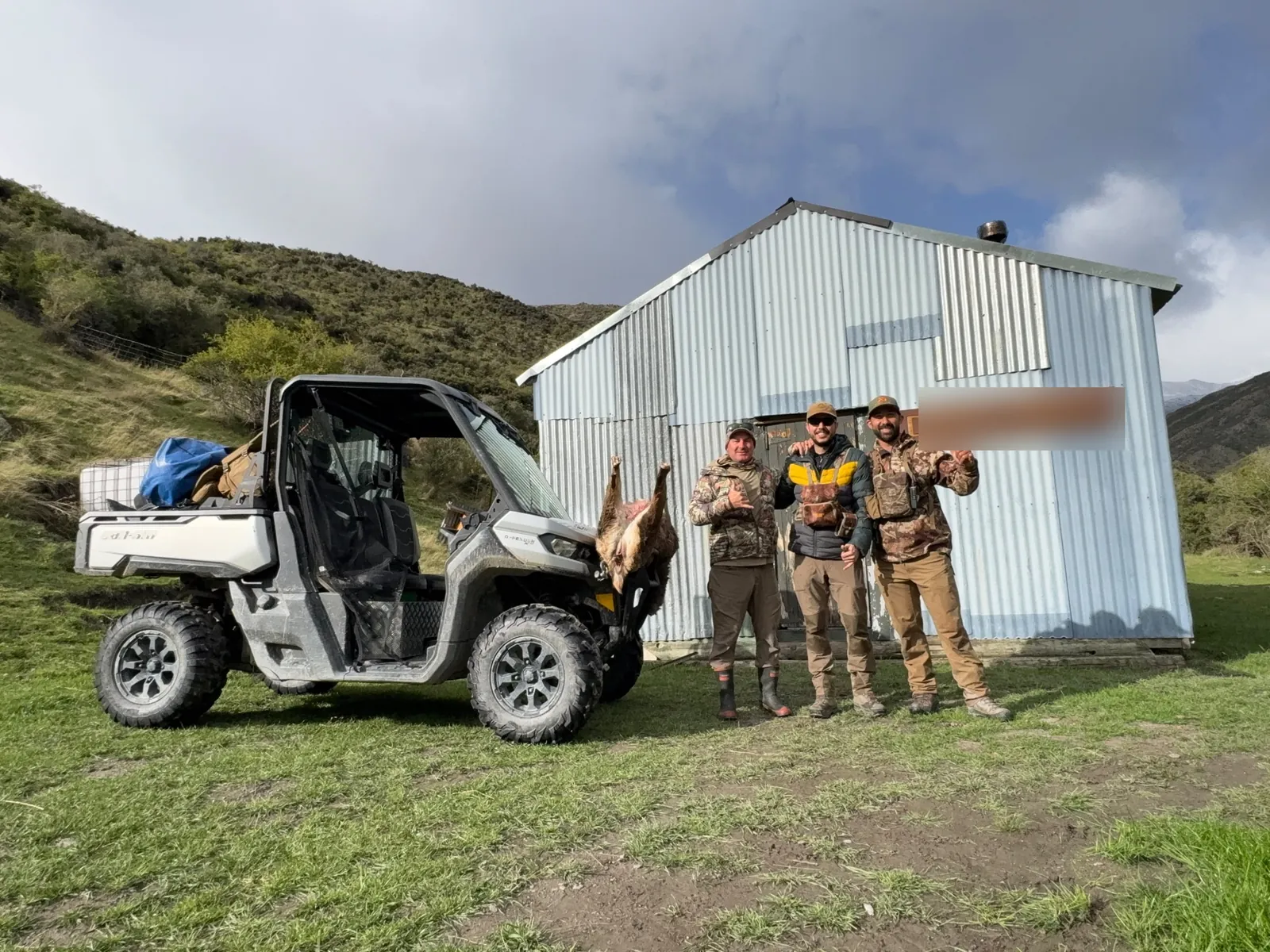
About 300 metres before the hut, where we were staying, the other hunter, Kieran, took a deer at 250 metres with a .300 magnum rifle. I'm not sure if the round was subsonic or not, but the sound shocked me. I was shaking and trying to control my breathing, because everything happened in seconds. He got off the buggy, opened his gun case, loaded the rifle, walked 10 steps and lay chest down on the ground. Two seconds later he made a good shot and the deer was dead.
These hunters are a different breed, especially the New Zealand ones. They are so good at spotting animals and taking the right shot, but that's what they do for a living. We drove down, unloaded the buggy and had lunch. The plan was for the guides to take us uphill, then for him to take the buggy back to recover the deer.
Getting ready
We arrived at the hut at noon. I asked Mark for more broadheads and he handed me a Terra Firma Venador two blade. I had been practising with G5 Montec broadheads. I arranged my arrows and we started walking. On the way Mark told me the dos and don'ts of staying quiet in the bush.
At a steep hill we sat down to catch our breath. This time Mark was carrying his .223 as a backup for any bad shots on my end, and I carried the bow. We were in radio contact with Kieran, and we asked him to spot goats from where he was. Soon he told us they were about 150 metres above us. We were sitting at around 400 to 500 metres, so we stayed put.
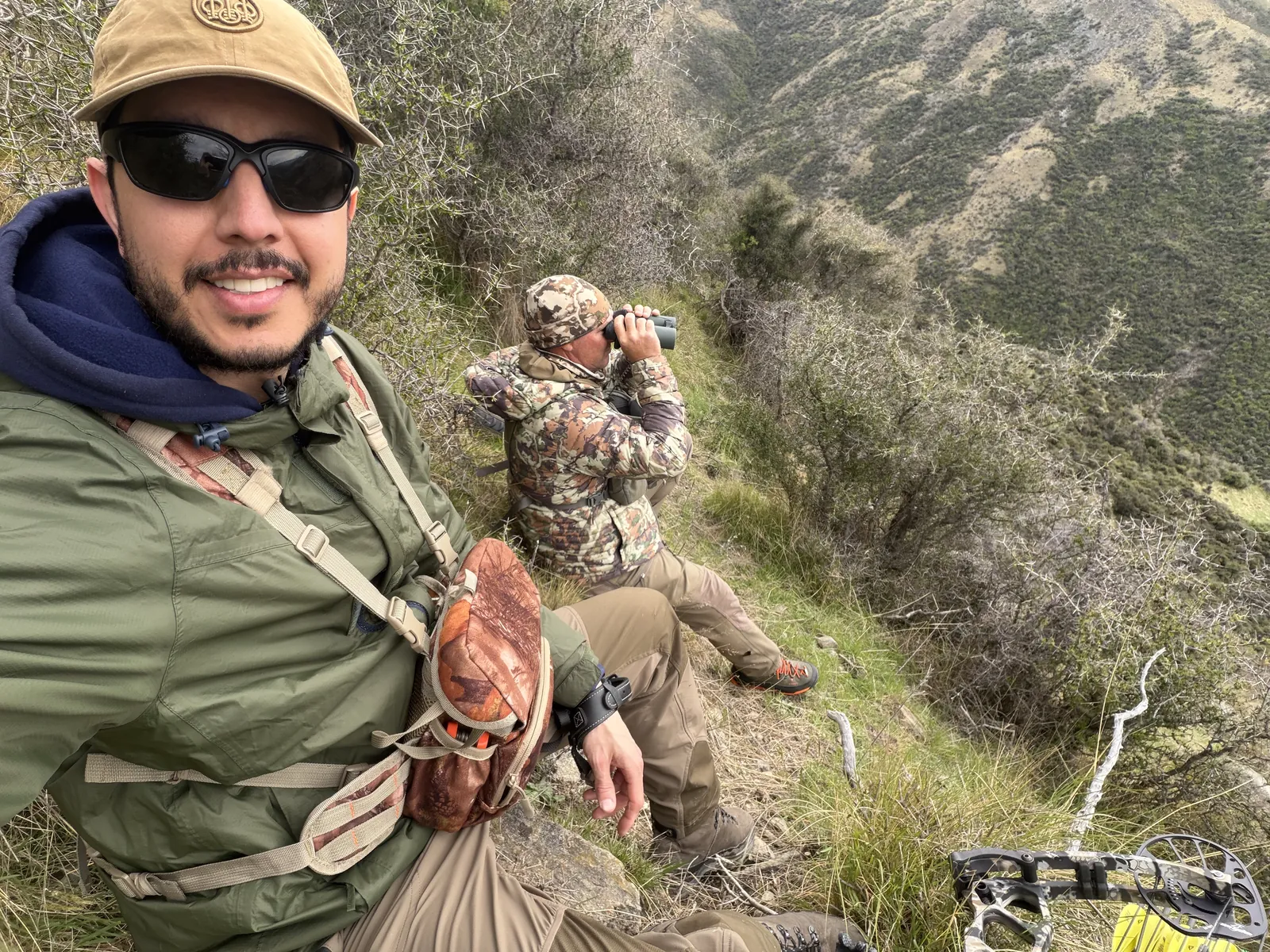
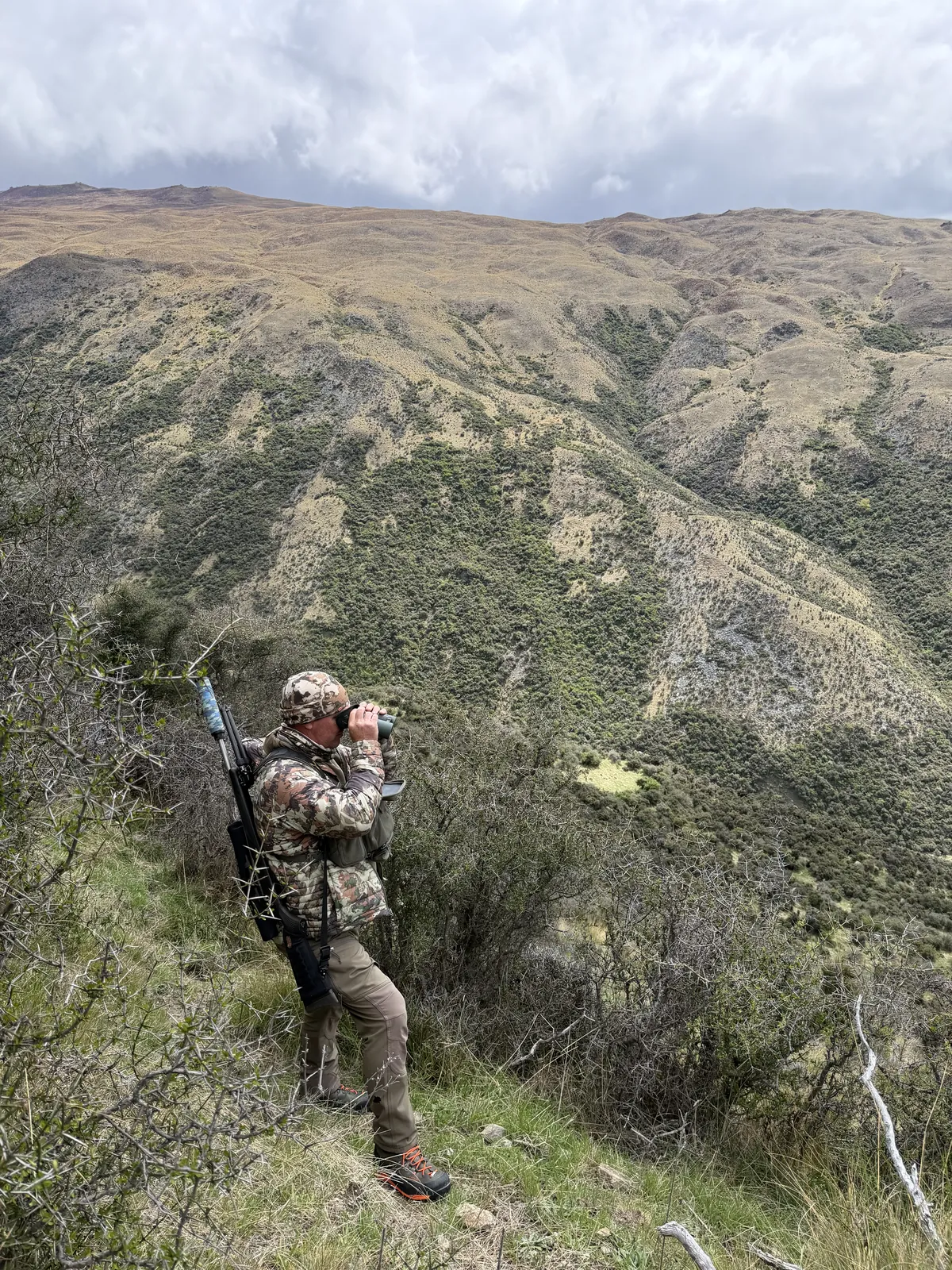
Shot one: the billy at 25 metres
Nothing happened for a while, until I spotted a big billy walking towards us. We slowly made our way down until he was 25 metres away. He was facing me, not quartered, and surrounded by bushes. I decided to nock an arrow and take the shot.
I was way up, adrenaline-wise, and I still don't know why, after training for this for months. The arrow missed, and Mark helped me recover it in all those bushes. To this day I don't know how he found it.
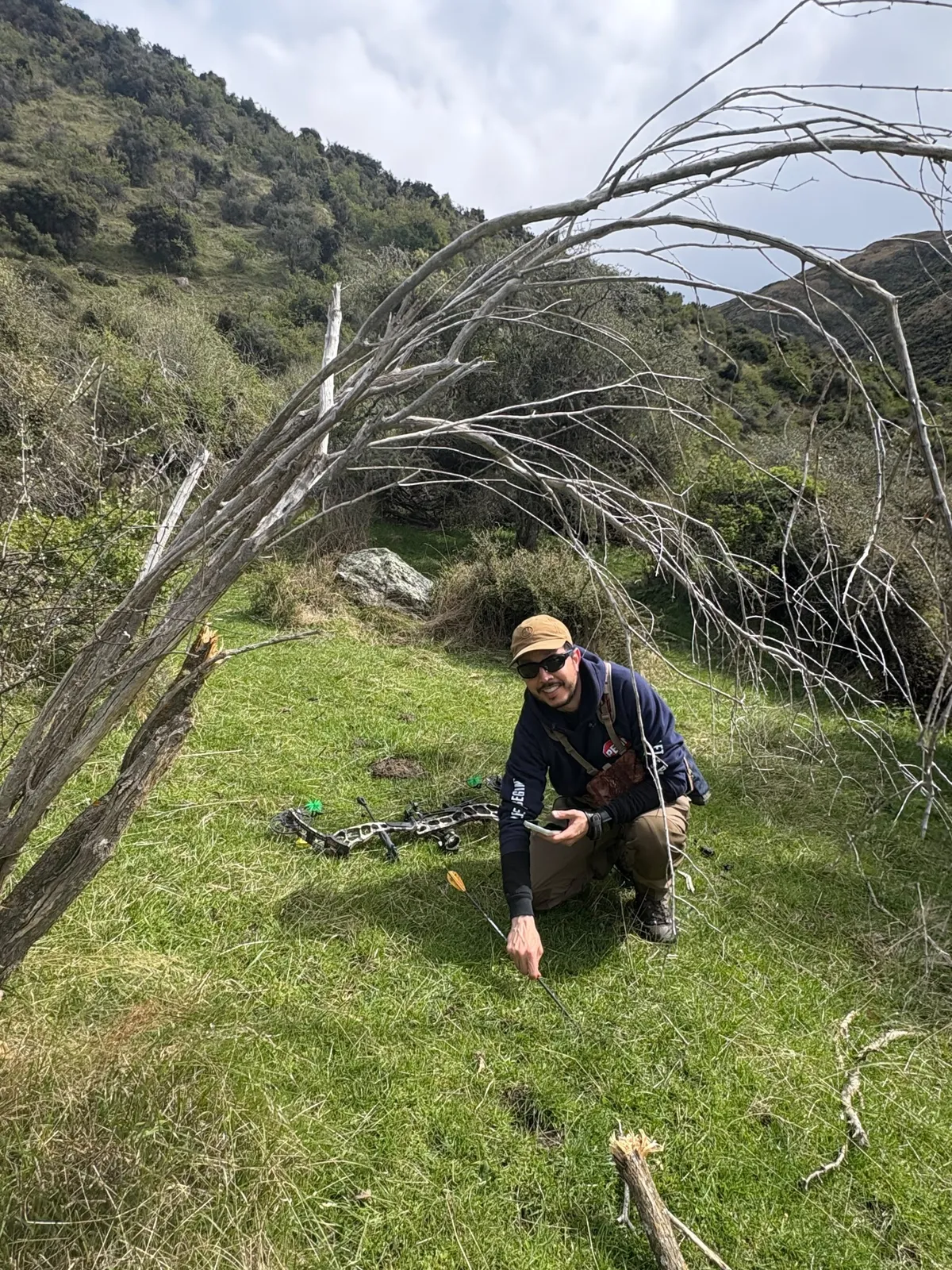
Good to know: A head-on shot is one most bowhunting guides tell you to pass on, because the vitals are small and well protected. Mark's advice all day was to wait for the animal to turn.
The blue hoodie
By then it was 3 pm, cloudy and rainy, but hot and humid. I was wearing four layers, including my favourite blue Penn fishing hoodie, and I had taken off my green waterproof jacket because I was literally wet through. Hunting clothes are expensive!
Mark was dressed for it, camo right up to his hat. He turned back to check where I was, and all I heard was: "Blue? Really? With a big red logo on the back? That's great, mate." My Spanish and English got tangled up. I figured I'd ruined the only shot I had, and the day was going to be slow because the animals had probably been spooked, which usually happens on a first hunt.
Shot two: the black and white billy
We sat down again and started glassing. I pointed out a black and white billy, 70 metres downhill. I thought I could make that shot, because I'd been grouping well at long range. Mark said no, let's get closer. "Take your time, don't rush the shot. Remember this, Manny: it's only rubber, like the ones we shoot at the range. Do you understand?" I nodded.
I started to blend in behind the bushes and tried not to get spotted. Mark helped me strap my green jacket to the back of my binocular harness. I kept ranging the billy, but I felt I wasn't moving fast enough, and I lost him twice in the bush. I kept working my way down, and suddenly he was 30 metres away.
I heard Mark's voice in my head, many times: wait, wait, let the goat quarter towards you. I drew back. Mark said something, but the adrenaline was already in my bloodstream and my breathing was broken. Still at full draw, I took a deep breath, put my 30 metre pin on the back of the goat, and let the arrow fly downhill with the brand new broadhead.
I remember watching the arrow fly slowly, and that feeling that you did the release right. It was poetry in motion. Then I heard Mark: "Yes, buddy, yes! He's down!"
Good to know: A downhill shot of 30 metres at around 15 degrees plays only about a metre shorter than 30 metres on the flat, because gravity acts on the horizontal distance. Our Shot Solver works out the number to dial.
I don't really know how that shot played out, because at that point I was shooting high on flat shots too.
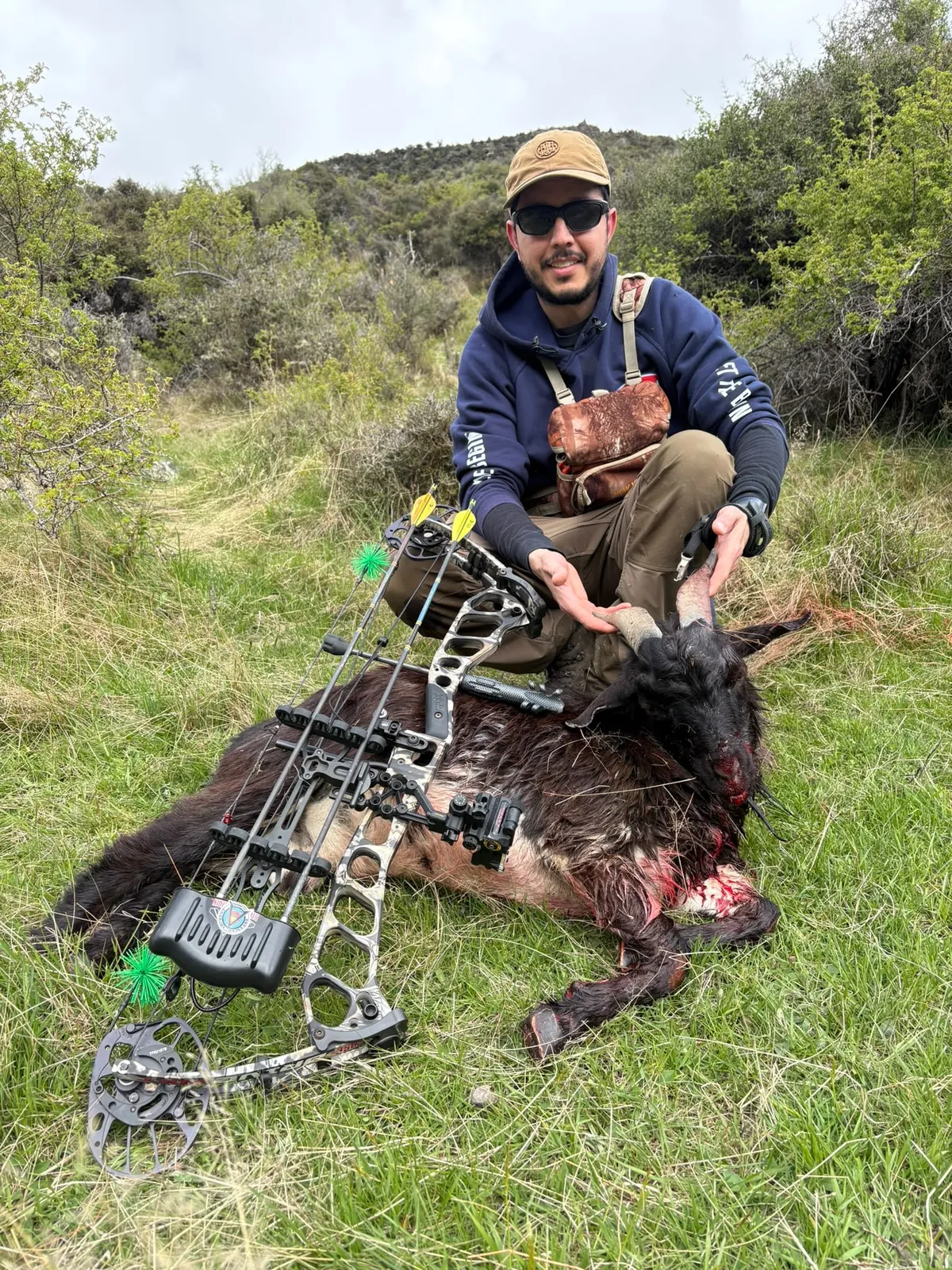
Two more photos from that moment are below. They show the animal and are blurred by default, so you only see them if you choose to.
Then it all fell apart
I already had another arrow ready for a follow-up. Another goat appeared and I took the shot without even ranging it properly. The arrow went high again. By then I knew something was wrong.
I took six steps, turned right, and there were four goats looking at me in a weird way. I just kept shooting, like Robin Hood. Mark had to step in and finish the job on two goats with the rifle. They were less than 10 metres away from me. I got so excited that I ran out of arrows, all four of them. Mark helped me recover most of them.
Then I made a really, really bad shot with the broadheads I'd been practising with. I'll be honest: I just framed the animal, I didn't really aim. The arrow didn't go through, and the goat ran off with the arrow still in it. We lost him, twice. The last time I shot at around 30 metres, if I remember right, and hit high again. The goat ran away, bleeding heavily through the middle, and the arrow fell out as he went. We lost that goat too. After the shoot-out, when everything was calm, we recovered the billy. I missed many opportunities and made bad shots, but thankfully Mark used the rifle and took the two goats that were hurt, and then we started recovering my arrows.
Good to know: Losing a wounded animal is the hardest part of bowhunting, and the honest answer is that it happens to nearly everyone, usually from rushing, high hits and poor ranging. That's why guides slow you down, and why we put so much into shot placement and verifying your sight marks before the season.
The search, and three clicks
Mark said the nanny wouldn't run far. We searched hard for two hours, then decided to go back to the hut. About 50 metres from it, Mark told me to take a shot at 20 metres so we could find out what was wrong with my bow. I shot, and of course it went high. I brought my sight down three clicks and the problem was sorted. Then I shot at 59 metres and missed by 8 centimetres.
Good to know: A sight can knock out of zero on a hard day in the bush, and a few clicks is all it takes to send every arrow high. That's why it pays to check your marks at a short distance before you hunt, and again if the bow takes a knock. Our guide to verifying your sight tape shows how.
An evening hunt in dense bush
My legs and feet were destroyed that day. It's spring in New Zealand and it gets dark around 9 pm, so by 7 pm Mark was ready for another quick hunt. He spotted two deer at 300 metres. We tried to blend in, but ended up trapped and scratched from head to toe in dense bush, and the deer spotted us about 150 metres before we got close. Mark is one of the best shooters and bowhunters I know personally. We went back with sore legs and finally made it to the hut.
Dinner at the hut
Before we left, Mark had put venison backstraps in to marinate, and Kieran gave us a tenderloin, so we could cook a proper dinner. Then Kieran put a heart and a liver from the deer he'd shot that afternoon on the table and said, "You're the chef, so let's see what you can do with it." I said to myself, challenge accepted.
I cooked offal before I got my culinary diploma, and I have no problem eating it. In Mexico we eat lots of it, from head to tail. The challenge here was cooking in the middle of nowhere with whatever spices previous hunters had left behind. I gathered onion powder, olive oil, chili powder, Worcestershire sauce, flaky salt and some freshly ground pepper, sautéed everything, and tried to keep it medium. It was so good, although we were all hungry, so I'm not sure how objective I am. We finished it all.
It was a lovely dinner: Japanese beer, wine and more beer, blue cheese, crackers and other delicacies they brought to the table. We had left the beer and wine cooling in the river, so it was cold. And the water, melted snow from the mountains, was the most pristine, clear and delicious I've ever had.
We lit the fire before leaving the hut that afternoon. It was a warm night, but we stayed warm, and it's always better to be warm than to face the cold of the mountains.
The next morning
At 7 am I heard some noises. Mark was gearing up, so I made coffee for the three of us. My legs were cramped and sore. After a couple of sips Mark looked at me and said he'd spotted some goats at 300 metres, and did I want to go for a quick hunt?
It was one of the toughest decisions, because inside I really wanted to go. But I had a house inspection with the landlord that day, and we had to pack everything into the buggy, drive back to the car and then drive back to Wānaka. The timing wasn't going to work, so I let it pass. Mark went out with his bow and came back soon after.
Watching a pro do it in four minutes
We packed and started the drive back. Kieran and Mark spotted a deer at 700 metres, one spotting and the other shooting, and the deer was down. It still amazes me that once they spot an animal it's seconds before the shot, and the rest is just recovery time.
We kept driving, and we spotted a goat at 80 metres. Mark hesitated. I told him, "Kieran got three deer, I got one plus three screw-ups, now it's your turn." He didn't think twice. He got his Hoyt RX10 carbon bow out of the case, stalked the goat and made a perfect shot at 40 metres. The goat went down. There was a second goat at 60 metres, but recovering the arrow would have been impossible, so he left it.
That's when I realised how important arrow recovery is. It's the first task after taking an animal with a bow, followed by the blood trail. Mark's broadhead was what looked like a SEVR Magneto 1.75 hybrid, and I think he was shooting 4 mm Terra Firma arrows. They fly flat and hit hard. I remember saying he was shooting around 70 pounds, and that was already excessive use of force.
They brought the goat down, and Kieran asked if Mark wanted the meat. He said no. Wild goats are treated as a pest here because unchecked numbers damage the landscape. This year there is even a nationwide effort, the National Wild Goat Hunting Competition 2026, run by the Department of Conservation and the New Zealand Deerstalkers Association. Hunters can enter from 1 August to 26 November 2026. Kieran took the two legs, packed them, and had them for dinner that day.
From the moment Mark took the bow out of the case to the moment I had the dead goat in front of me was around four minutes. When you hunt with professional guides, it's a matter of minutes. They are fast and effective, they are full of knowledge, and I can't wait for my next adventure with Mark.
Hunt with Mark
Mark runs a business called Alpine Archery in Wānaka. You can message him on Instagram and he will try to accommodate a proper hunt depending on your experience and what you're after. He regularly takes hunters on heli trips and all sorts of other ways to get to the right spot.
Thank you
Thank you for reading. I'll try to keep this blog active as I follow my journey as a bowhunter. Thank you to all my mentors, especially Mark, Richard Barnett, Taewa (Bucky) and many others.